Nutrition Label Overview
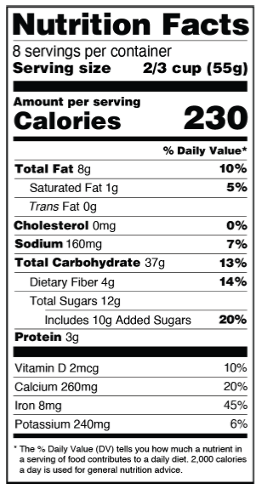
Nutrition Facts panels, also known as nutrition labels, are standardized labels that show the nutritional content of packaged foods and beverages. Each country has their own formats and regulations. In the United States, these are regulated by the FDA. As a dietitian who has created compliant U.S. nutrition labels for a major food company for 5 years, I’m well versed on the intricacies of U.S. nutrition labeling. In this article, I’ll share what elements are required on an American nutrition label and tips on how to read one. I’ll also provide industry insights and highlight areas to pay attention to as you travel. The sample nutrition label example used throughout is from FDA.
Serving Size
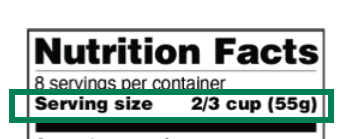
The first thing to consider when reading a nutrition label is the serving size. In the United States, a product’s serving size is at the top of a label. It is bolded and features a quantity in both a household (cup, oz, Tbsp, slice, etc) and metric (grams, milliliters) measure. The serving size indicates the amount of food used to calculate the nutrition values listed on the label. If you’re eating more or less amount of this amount of product, then you need to scale all nutrition information accordingly.
Contrary to popular belief, food companies and manufacturers actually don’t choose the serving sizes of their products. The quantity is actually set and regulated by FDA. Government controlled serving sizes is a good thing. It prevents manipulation of serving size to make certain nutrients appear higher or lower. For example, a snack company can’t make the serving size on a bag of chips extremely small to make sodium content appear lower. Standardized serving size is also advantageous to the consumer. When every brand of the same food uses the same serving size, product comparison is easier while shopping. No matter what brand of potato chip a consumer is considering buying, the serving should always be about 1 oz.
How is Serving Size Determined?
Serving size is meant to be a reflection of a typical portion consumed, not a recommendation or limit of how much you “should” be eating. For example, a serving of bread is one slice, but most people would need multiple servings to have adequate carbs for their meal.
Per FDA, a serving of food should reflect the amount of food “customarily consumed”. 1 Using national nutrition data from a CDC survey called NHANES (National Health and Nutrition Examination Survey), FDA establishes target quantities of food for every food category you can think of – snacks, bread, ready to eat stews, frozen vegetables, etc. These target quantities are called reference amounts and are used by food companies to label serving size. Reference amounts are public information. You can see FDA’s reference amounts for any food categories in the Code of Federal Regulations here.
Reference amounts are published in grams, which is precise, but not easily understood by the average American since we use the customary system. Consequently, FDA requires that labels use “household measures,” like cups or teaspoons, to be more consumer friendly.
To choose a serving size for a nutrition label, food companies find the household measure closest to FDA’s reference amount. For example, FDA says the reference amount for vegetables without sauce is 85 grams. To determine the serving size of some frozen broccoli, a broccoli company would see how many cups of their frozen broccoli is closest to 85 grams. This is rarely exact, so the label might read, “Serving Size: 1 ⅓ cups (83 g). This same process is followed for cereal, cookies, chips, etc.
Dietitian Takeaway – Serving size is a reflection of a typical portion consumed, not a recommendation for intake. For example, a serving of vegetables on the label may be ⅔ cup, but in reality, you may need 2 cups per meal. Compare the serving size to how much you’re actually eating to know if you should scale the nutrients you’re looking at.
Calories
After serving size, calories are listed. Calories are a measure of energy provided by a food. These are required to be listed in large, bold font on all U.S. nutrition labels.
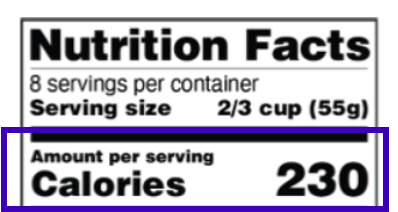
Calories can be calculated various different ways, including taking the caloric value of every ingredient, adjusting for quantity in the recipe, and rounding. For a quick check, use the 4-4-9 rule. In nutrition, the 3 macronutrients that typically contribute calories are protein, carbs, and fat. Protein and carbs provide 4 calories per gram, and fat provides 9 calories per gram. If you multiply the grams of protein and carbohydrates by 4, and grams of fat by 9, then sum together, you should have an approximation of total calories.
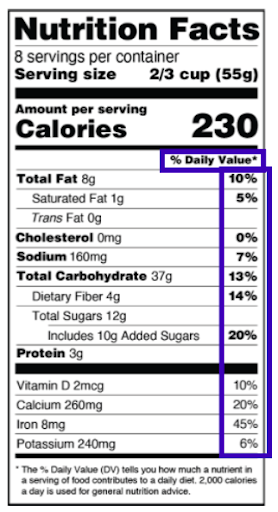
Using the nutrition label above,
- 3 g protein x 4 calories/gram =12 calories
- 37 g carbs x 4 calories/ gram =148 calories
- 8 g fat x 9 calories/gram =72 calories
- 12+148+72=232 total calories
Calories listed on food labels are subject to rounding rules.2
- Up to 50 calories/serving → Round to 5 calorie increments
- Above 50 calories/serving → Round to 10 g increments
- If <5 calories/ serving, can be expressed as 0. For example, gum.
This means that if a food is 73 calories per serving, it would be rounded down to the nearest 10 calorie increment and would appear as “70 calories” on the label. In our example above, you can now see why 232 total calories is rounded to 230.
Dietitian Takeaway – Calories are the most prominent piece of information on a U.S. nutrition label. The value is rounded based on standardized rules, so know that the number isn’t exact. Calorie needs vary from individual to individual, and may increase or decrease depending on your activity level during your trip.
% Daily Value
“Daily Values” are reference amounts developed by FDA to help consumers understand how much of a nutrient they should aim to get—or limit—each day. 3 These values are based on scientific recommendations from the Food and Nutrition Board and are intended to reflect the needs of the average healthy adult.
On a nutrition label, the % Daily Value (%DV) shows how much a nutrient in one serving of a food contributes toward the daily value target described above. For example, in the nutrition label below, a serving provides 20% DV of calcium. This means that eating 1 serving supplies about one-fifth of the recommended daily amount. You’d have to eat 5 servings of the product to reach the daily recommended calcium intake level. It’s important to remember that % Daily Values are calculated using a 2,000-calorie daily diet as a general reference point. Because individual calorie and nutrient needs vary based on factors like age, activity level, and health goals, %DV should be viewed as a helpful guideline rather than a personalized recommendation. They can provide direction on the nutrition quality of your food, but may not be the most accurate gauge for your goals.
Why do some nutrients not have a % DV?
You may notice that a few nutrients on the Nutrition Facts label list the amount per serving but do not include a % Daily Value (%DV). This usually happens when there isn’t a single recommended daily intake that applies to most people.
Protein
Protein typically does not display a %DV because it is not considered a nutrient of public health concern in the United States—most Americans already consume enough. In addition, individual protein needs can vary widely depending on factors like body size, activity level, and life stage.
However, if a product makes a protein-related claim on the package (for example, “good source of protein”), the label must include a %DV. In these cases, the percentage is adjusted to account for the body’s ability to digest and absorb the protein, which can vary by food source.
Total Sugar
Total sugar does not have a %DV because no official daily recommended limit has been established. While we know that excessive sugar intake can negatively affect health, scientific guidelines have historically focused on limiting added sugars rather than total sugars from all sources. For this reason, you’ll see a %DV listed for added sugars, but not for total sugars. 4
Trans Fat
Trans fat also does not have a %DV. Instead of recommending a specific amount, the U.S. Food and Drug Administration advises keeping trans fat intake as low as possible, since it is associated with increased risk of heart disease. 5
Interpreting %DV
Any %DV less than 5% is considered “low.” Most of the time, aim to keep sodium and saturated fat in this range. 20% or more is considered “high”. Ideally, vitamins and minerals like vitamin D or calcium are closer to this amount. In the example label above from FDA’s website, the added sugar is high at 20%. The saturated fat, at 5%, is low.
Dietitian Takeaway – When traveling, seek to keep sodium low and fiber and potassium high to reduce swelling and bloating and promote digestion. Foods like fresh fruits and vegetables that don’t require a nutrition label will check all 3 of those boxes.
Mandatory Nutrients
In the U.S. all nutrition labels are required to display the following list of nutrients. These are based on nutrients to limit to reduce chronic disease (such as saturated fat and sodium) and those that are commonly underconsumed, such as potassium and vitamin D. There are a few exceptions for products with small package sizes or when the total content is 0 (think water).
- Total Fat
- Trans Fat
- Sat Fat
- Cholesterol
- Sodium
- Carbohydrates
- Total Sugar
- Added Sugar
- Protein
- Vitamin D
- Calcium
- Iron
- Potassium
Optional Nutrients
Other nutrients are voluntary on U.S. nutrition labels or only required under specific circumstances, such as when a marketing claim is made on pack (“Low Fat”) or if the product is fortified with additional vitamins and minerals, like many breakfast cereals.
For example, while total, trans, and saturated Fat are required to be declared, mono- and polyunsaturated fats, the heart healthy ones, are optional, unless a fat or cholesterol claim is made on pack. 6 Similar regulations apply for soluble/insoluble fiber and sugar alcohols.
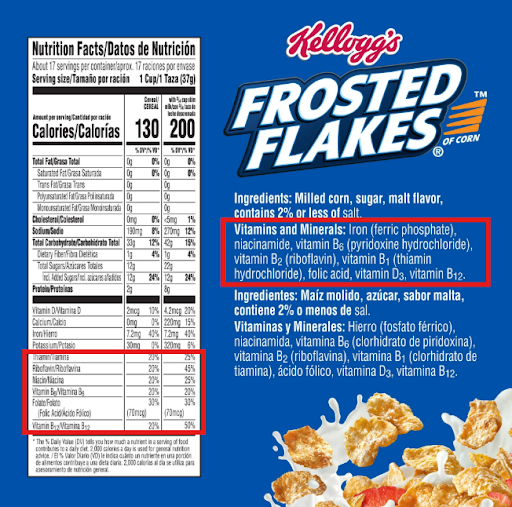
Vitamins and minerals beyond those listed above are generally voluntary on the Nutrition Facts label. However, if a manufacturer adds them to a product—such as in fortified foods—they must be declared. For example, Kellogg’s fortifies Frosted Flakes with several B vitamins, so those nutrients are required to appear on the label.
Accuracy of Nutrition Labels
While food companies are bound by law to be “truthful and not misleading” with their nutrition labeling, there is a degree of variability. All labels are approximate as it would be impossible to share exact values without lab testing every single box or package of product.
80/120 Rule
Specifically, U.S. federal regulations allow for a 20% variance in listed nutritional values. 7 This means that even if your protein bar says it has 20 grams of protein per serving, by law, it could actually be anywhere from 16-24 grams per serving, 80-120% of the declared value.
This range allows for crop variation and supply chain changes. For example, every crop of wheat will not have the exact same level of fiber, B vitamins, or calories, because every crop of wheat experienced a different amount of rainfall, sunlight, etc. Additionally, a company may have multiple suppliers for the same ingredient with slight variations in nutrition content. Think of it like buying different brands of canned tomatoes, or dried beans.
Rounding Rules
Just like calories are rounded on the label, so are other nutrients. For example, sodium rounding changes based on the total amount in a serving of food.
- <5 mg/serving – 0 mg declared on label
- 5-140 mg/serving – nearest 5 mg increment
- >140 mg/serving – nearest 10 mg increment
A food with 138 mg of sodium would be rounded to 140 mg/serving.
For the full list of all nutrients rounding rules, see 21 CFR 101.9 (c).
Dietitian Takeaway – Nutrition labels are a good overview of the nutritional quality of a food, but they’re not exact. Focus high level on keeping fiber, protein, and vitamins and minerals high, with added sugars and sodium low. Choose unlabeled whole foods, like raw fruits and vegetables, as often as possible.
Ingredient Line
After the nutrition facts panel, in the U.S. food products are required to list ingredients of the food in “order of predominance” by weight. This means that the ingredient used in the highest quantity is listed at the beginning, with the smallest amount listed at the end. In the Ezekiel bread example below, there’s more organic sprouted wheat than filtered water.

Some ingredients are exempt from ingredient labeling, meaning that they don’t have to be listed. “Incidental additives” are ingredients of ingredients that don’t function in the finished product. For example, tricalcium phosphate (TCP) is a common anti-caking agent added to salt to keep the granules from clumping together. If a salt with the TCP is used in a cookie, the TCP only functions in the salt, not the cookie. The amount of TCP is considered insignificant per serving of cookie, so it’s not on the ingredient list.8
Finally, certain ingredients can be grouped together under one name on an ingredient line to protect a supplier’s confidential recipe formulas. For example, a product with parsley, oregano, and basil could simply group as “spices” on the ingredient line. Similarly, if a vanilla and a butter flavor are both used in an ice cream, by law, the ice cream company could combine and just list “artificial flavors” to encompass both.9
Dietitian Takeaway – Look for foods that have whole food ingredients listed first – things like wheat, milk, black beans, etc. Length of ingredient statement doesn’t necessarily correlate to the health of a product. For example, the bread ingredient statement above is very nutritious and wholesome, but has 11 ingredients. Conversely, deep fried potato chips can have as few as 3 ingredients – potatoes, oil, salt.
Allergens
After the ingredient list, any allergens present in the food product are required to be declared. Labelled allergens actually differ from country to country. For example, Canada labels mustard and sulfites as allergens, unlike the U.S. In the United States, the following ingredients are considered mandatory allergens:
- Eggs
- Fish
- Milk
- Peanuts
- Sesame
- Shellfish
- Soybeans
- Treenuts
- Wheat
“Contains” means that one of the ingredients listed above is directly added to the product as an ingredient. For example, a carton of yogurt would must say, “Contains Milk.”
“May Contains” are precautionary allergen statements. These are voluntary and indicate that the listed ingredient is used on the same production line or facility. For example, a shortbread cookie may say, “May contain traces of peanuts” even though there aren’t any peanuts in the cookie. It’s a warning of cross contamination in case a trace of peanut from a different recipe wasn’t fully washed from the baking machine.10
Conclusion
In summary, nutrition labels in the United States are heavily regulated for packaged foods and beverages. Labels are designed to highlight nutrients that influence chronic disease. Serving sizes are standardized to avoid manipulation.
Key takeaways:
- Always reference serving size.
- Focus on increasing fiber and vitamins while decreasing sodium and added sugar.
- Remember that nutrition information is approximate – ultimately rely on your own hunger/fullness, digestion cues, etc.
- The best foods to eat – fruits, vegetables, meats – don’t require a nutrition label!
What questions do you have on U.S. nutrition labeling? Leave them in the comments below.
References
- https://www.ecfr.gov/current/title-21/section-101.12 ↩︎
- https://www.ecfr.gov/current/title-21/part-101/section-101.9#p-101.9(c)(1)- ↩︎
- https://ods.od.nih.gov/HealthInformation/dailyvalues.aspx
↩︎ - https://www.fda.gov/food/nutrition-facts-label/added-sugars-nutrition-facts-label#:~:text=There%20is%20no%20Daily%20Value,to%20eat%20in%20a%20day ↩︎
- https://www.fda.gov/regulatory-information/search-fda-guidance-documents/small-entity-compliance-guide-trans-fatty-acids-nutrition-labeling-nutrient-content-claims-and#:~:text=Consequently%2C%20when%20the%20amount%20of,as%20low%20as%20possible%22%20required ↩︎
- https://www.ecfr.gov/current/title-9/chapter-III/subchapter-A/part-317/subpart-B#p-317.309(c)(2)(iii) ↩︎
- https://www.fda.gov/regulatory-information/search-fda-guidance-documents/guidance-industry-guide-developing-and-using-data-bases-nutrition-labeling#how ↩︎
- https://www.ecfr.gov/current/title-21/section-101.100 ↩︎
- https://www.ecfr.gov/current/title-21/section-101.22 ↩︎
- https://www.fda.gov/regulatory-information/search-fda-guidance-documents/guidance-industry-questions-and-answers-regarding-food-allergen-labeling-edition-5 ↩︎
Great post! I haven’t been in years but it brings back some great memories. I remember being fascinated by the…
Great post! I haven’t been in years but it brings back some great memories. I remember being fascinated by the…
That stairwell 😍
Jenna!!! This is a lovely post! Moving Norway to the top of my bucket list! ❤️


Leave a Reply